If you’ve ever handled a roll of flux-cored wire, you’ve probably noticed that it arrives on a tight, uniform spool with no loose strands, no exposed flux cores, and packaging that holds up through cross-country shipping and months of warehouse storage. As a supplier of flux-cored wire manufacturing machines, I’ve spent thousands of hours walking customers through every part of our equipment—from the raw material hoppers that feed steel strip and flux powder to the final cutting and packaging station that turns a thin, continuous 15,000-foot wire into something ready for a welder’s spool gun. The packaging system is one of the most underrated, most critical parts of the whole process. Get it wrong, and even the highest quality wire will get tangled, damaged, or contaminated before it ever reaches a job site. Flux-Cored Wire Manufacturing Machine
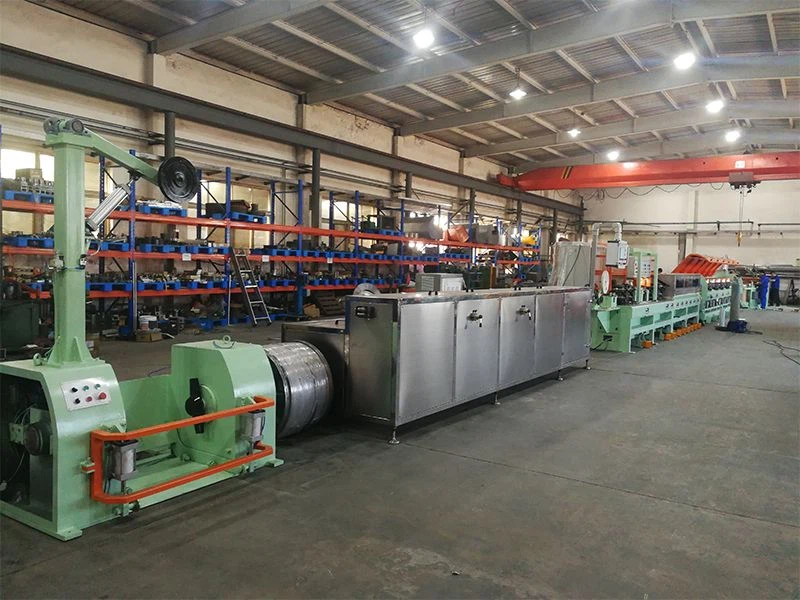
Let’s break this down step by step. When a flux-cored wire manufacturing line runs, the finished wire exits the final annealing and surface conditioning section at speeds that can hit 1,200 feet per minute—fast enough that a single misalignment in the packaging system will throw off the entire line’s output. The packaging system isn’t just one machine; it’s a series of integrated stations that work together to spool, weigh, label, wrap, and palletize the wire, all with precision that matches the tight tolerances required for welding wire.
The first stop after the wire leaves the production line is the spooling station, and this is where the system’s core starts. Unlike solid wire, which is round and easy to wind, flux-cored wire has a soft flux core inside a steel outer shell. If you wind it too tight, the core can crush, leading to inconsistent weld performance. If you wind it too loose, the wire will shift during handling, creating tangles that welders hate. Our machine’s spooling system uses a precision-controlled dancer arm that applies constant, adjustable tension to the wire as it’s wound. This arm is connected to a load cell that measures tension in real time—if the tension drops too low, the line’s puller rollers speed up slightly; if it gets too high, the rollers slow down. We calibrate this system for every wire type, from 0.035-inch thin gauge used for thin sheet metal to 0.120-inch heavy gauge for structural steel. For example, when manufacturing 70S-6 flux-cored wire, we set tension at 1.2 pounds per square inch, which keeps the wire evenly wound without compressing the flux core.
Next, the spooling station has to handle different spool sizes, because customers buy wire on everything from 1-pound test spools to 2,000-pound industrial drums. Our packaging system uses quick-change mandrels that let operators swap between spool sizes in under 15 minutes, no special tools needed. Once the spool is full—usually a set length like 330 pounds for a standard 12-inch spool—a length sensor triggers a cut, and the wire is trimmed cleanly without leaving sharp ends. This is a key detail: sharp wire ends can poke through packaging, or tangle with other spools during shipping, so our system uses a shear cut that creates a smooth, flat edge every time, not a crimped or torn end.
After spooling comes the weighing and quality check station. You can’t send a spool of wire without knowing exactly how much is on it, especially for industrial customers who price wire by the pound. The packaging system has a precision scale integrated right into the line that weighs each spool automatically. If the weight is off by more than 0.5%—a common tolerance for welding wire—the system flags it and diverts the spool for reprocessing, so only properly weighted units leave the line. We also add a vision check here: a high-resolution camera scans the spool to make sure the wire is wound evenly, no gaps or overlapping layers. If the camera detects a misalignment, the line pauses, and an alert pops up on the operator’s HMI (human-machine interface) so they can fix the issue before the spool moves on.
Once a spool passes the quality check, it moves to the labeling and wrapping station. Labeling might seem like a small part of the packaging system, but it’s critical for customers. Welders need to know exactly what type of wire it is, its diameter, AWS classification (like A5.20 for carbon steel flux-cored wire), heat number, and compliance standards. Our packaging system uses a thermal transfer label printer that prints high-resolution, smudge-proof labels that stick even to moisture-resistant packaging. The printer is programmed to pull product data directly from the manufacturing line’s database, so there’s no chance of a label mismatch—if the spool is 0.045-inch E71T-1, the label will say that, no typos, no wrong specs.
After labeling, the spool gets wrapped for protection. This isn’t just a plastic bag thrown over the spool—flux-cored wire is porous, especially low-hydrogen types, and moisture contamination can ruin welds. Our packaging system uses a two-step wrapping process: first, a layer of moisture-barrier polyethylene film that seals the spool completely, then a layer of heavy-duty stretch film to hold the bag tight and protect it from physical damage. For large drums over 1,000 pounds, we add a corner protection layer made of corrugated cardboard and foam, so the drum doesn’t get dented during handling by forklifts. The stretch film also has UV protection for customers who store wire outside for short periods, which is a common need for construction and fabrication shops.
The final stage of the packaging system is palletizing, which turns individual spools or drums into a unit load that’s easy to ship and store. For small shops that use 10- or 25-pound spools, the system stacks them neatly on pallets with dividers between layers to prevent scratching. For large drums, the system places them in a tight grid, secured with steel strapping that meets ISO shipping standards, so the load won’t shift during long-haul trucking. We also integrate a RFID tagging system into our packaging for customers with large warehouses. Each pallet has a small RFID tag that stores all the product data, so warehouse managers can scan the pallet once instead of counting each spool individually, which cuts down on inventory errors.
Now, let’s talk about why this matters, especially from a machine supplier’s perspective. Too many manufacturers focus only on the production part of the flux-cored wire line, assuming that packaging is an afterthought they can handle with off-the-shelf equipment. But that’s a mistake. A bad packaging system will lead to higher return rates, customer complaints, and wasted product. For example, last year we worked with a mid-sized wire manufacturer who bought a low-cost line from a overseas supplier. Their packaging system was basic: a spooler with fixed tension, a manual scale, and a hand-wrapped plastic bag. They were losing 12% of their output to tangled wire, underweight spools, and moisture damage. When they upgraded to our line’s integrated packaging system, that number dropped to 1.8%, and their customer retention rate went up by 20% in the first year. That’s the kind of impact a well-designed packaging system has on a business’s bottom line.
Another thing I always emphasize to customers is adaptability. The welding industry is always evolving—new wire alloys, new spool sizes, new shipping requirements. Our packaging system is designed to scale with those changes. The tension settings can be adjusted for new wire formulas, the mandrels can be replaced for custom spool designs, and the labeling software can be updated to meet new industry standards (like the 2022 AWS labeling updates for low-hydrogen flux-cored wires). We also offer customization for customers who need specific packaging: if someone ships wire to locations with extremely humid climates, we can add a desiccant packet dispenser that automatically puts a small desiccant bag inside each spool’s packaging. For customers who sell directly to consumers, we can switch to smaller packaging for 1-pound spools with hang holes for retail display.
I should also mention the integration part. The best packaging system doesn’t work in a vacuum—it talks to the rest of the manufacturing line. When the annealing section finishes heating the wire, it sends a signal to the packaging system to get ready for the next spool. When the flux powder feed rate changes, the HMI updates the tension settings in the spooling system automatically. This sync reduces downtime because the line doesn’t have to pause between runs to adjust settings manually. For our customers, that means higher throughput, less labor, and lower operating costs. The packaging system operators just need to monitor the HMI, fix small issues, and do routine maintenance—no need for specialized training in packaging engineering.
Now, let’s address a common question I get: how does the packaging system handle different types of flux-cored wire? Flux-cored wire comes in two main categories: self-shielded and gas-shielded, and each has different needs. Gas-shielded wires, like E70S-6, have a tight flux core and are less prone to moisture damage, but they still need even winding to feed smoothly through a welding gun. Self-shielded wires, like E71T-8, have a higher flux content to protect the weld, so they’re softer and more prone to crushing. Our packaging system is calibrated for both: for gas-shielded wires, we use slightly higher tension to keep winding tight, and for self-shielded wires, we reduce tension by 15% to prevent crushing the core. The system’s load cell technology makes this adjustment easy—operators just select the wire type on the HMI, and the system sets all the corresponding parameters automatically.
Routine maintenance is another key part of keeping the packaging system running well, and it’s something we include as part of our customer support package. We provide a detailed maintenance schedule that covers everything: checking the shear cut blades for sharpness every 500 hours, calibrating the tension load cell once a month, replacing stretch film rollers every 2,000 hours, and cleaning the vision camera lenses daily. We also offer on-site training for operators and maintenance teams, and 24/7 technical support for any urgent issues. One of our customers in Texas had a small problem with the palletizing system’s strapper on a Friday afternoon, and our technician was on site by 8 a.m. Saturday, getting it fixed in two hours so they wouldn’t miss a shipping deadline. That’s the kind of support that matters when a customer relies on their line to meet orders.
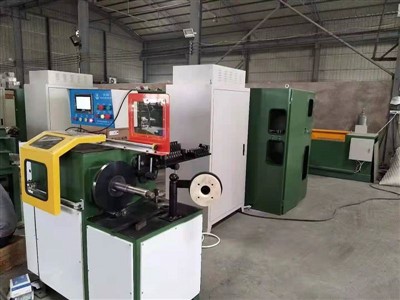
At the end of the day, the packaging system of a flux-cored wire manufacturing machine is more than just the last step of production. It’s the bridge between a well-made wire and a welder’s job. It ensures that every spool that leaves your facility is as high quality as the wire inside, that it feeds smoothly, that it doesn’t get contaminated, and that it arrives on time. As a supplier, I’ve built our business on designing packaging systems that work as hard as the rest of the line, that adapt to our customers’ needs, and that reduce waste and downtime. If you’re looking to upgrade your flux-cored wire manufacturing line, or if you’re curious about how our packaging system can improve your operation, I’d encourage you to reach out. We can walk through your current challenges, show you how our system works, and tailor a solution that fits your production volume and product needs.
Welding Wire Auxiliary Equipment References:
- American Welding Society (AWS). A5.20: Specification for Carbon Steel Electrodes for Flux Cored Arc Welding. 2022.
- Groover, M. P. Fundamentals of Modern Manufacturing: Materials, Processes, and Systems. 7th ed. John Wiley & Sons, 2020.
- Welding Journal. "Packaging and Handling Best Practices for Flux-Cored Wires." Vol. 99, No. 3, 2020, pp. 45-51.
- Manufacturing Engineering Magazine. "Integrated Packaging Systems for Wire Production Lines." Vol. 165, No. 4, 2021, pp. 78-83.
Three Water Machinery Co., Ltd.
Three Water Machinery Co., Ltd. is one of the most reliable manufacturers and suppliers of flux-cored wire manufacturing machine in China. With abundant experience, we warmly welcome you to buy advanced equipment for sale here and get quotation from our factory. Contact us for more details.
Address: No.15, Jiaye Road, Liuanzhuang Industrial Park, Beichen District, Tianjin, China
E-mail: sales@eqet.com
WebSite: https://www.eqet.com/
